
Search site
Contact
Marie-Josée J.Fleming
E-mail: mj.fleming@hotmail.com
Photography Tips
Here in photography tips you can find a variety of information you can use when editing a picture, aswell as different tutorials.
Here are different tricks you can on your photography.
Using Colors Effectively in Digital Photography by Wayne Turner
Whenever I go out on a photo shoot I love to include as much color and as bold as possible. Color is more important to our worlds than we think and is often taken for granted. Although monochrome photos are great, there is more to color photography than we think. A few techniques mentioned in this article will add a dramatic dimension to your images.

"Blue" captured by Anya Kozyreva
As with all photography you must always think before you shoot an image. Take the time to ponder the scene and work out what works in the composition. Look at what colors are available and where they are, how much color to include and how to use it. By applying a few simple techniques you images will be admired and result in great satisfaction for you.
This is a great technique for a bold photograph. By isolating a color or at the very least making it the dominating color you create images that are bold and dramatic. Key to this is finding objects or scenes that have just one color yet make an effective composition. Get in closer to the subjects isolating from their surroundings and making the color the focal point.
When shooting in color just a subtle light change can result in a very different image. A sudden change in cloud cover will enrich the colors and make them appear more saturated. When shooting in the morning or evening they will look warmer and when the sun is higher they will look cooler. Shooting in bright shade will also make them look richer. So always be aware of the light quality and get to know which times in the day give you the best results.
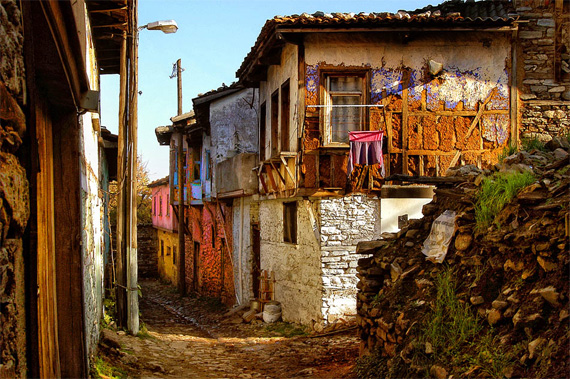
"Cumalıkızık Houses" captured by Halim TOKEL(VIRBOVCA)
This is how rich or deep the colors appear to be. Well saturated colors appear bright and make really colorful images, which is what you want to achieve on most occasions. To do this in camera is quite simple but you need to be careful not to overdo it. By using your aperture compensation usually denoted by the Ev setting on you camera, you can very slightly underexpose the photo by a third to half a stop. This will increase your saturation. Too much though will make the final image dark and muddy. With digital photography you can also adjust the saturation using the slider in Photoshop.
By getting to know your color wheel and where the various colors are situated you will see that colors opposite each other are contrasting. When you create a colorful photo, look for colors that are next to each other in the scene that contrast. Be careful that one doesn’t dominate the other so shoot in strong light. You want the colors to capture the attention like a bright red subject on a bright green background.
<Repetition and Patterns in Photography by Tedric Garrison
The root word of repetition is “repeat”. When you repeat a certain size, or shape or color you add strength to the overall image. Repetition is a basic concept in the world of art. If you want to make a statement, you repeat certain elements again and again. If you repeat something once or twice it becomes more interesting. If you repeat something many times it becomes a pattern and takes on a life of its own. Patterns give us order in an otherwise chaotic world. There’s something fundamentally pleasing about seeing order in such a way that we know what to expect. In most cases, repetition is a tool used to calm the viewer, making them feel comfortable and at peace while enjoying the view.

Photo captured by Mohammad Amziry bin Roslan
A single, simple subject with a plain non-distracting background definitely has its strengths, but it is NOT the only way to keep a viewers attention. Patterns are to photography, what Rhythm is to music. Without the limitation of just a single point of interest, repetition helps your eye dance from point to point with pure delight. You are not asked to make a judgment of the subject, simply to explore it. Like music, you are not expected to just listen to a single note, but to take in the high notes, low notes, the movements, and the beat. The goal here is not to just witness a good photograph, but to experience it. Thus, when repetition is used correctly . . . it can greatly increase the emotional impact of your images.
Patterns and repetition can be found all around us: a row of trees, a field of sunflowers, or a line of children waiting for a bus. When you get into the world of Close-Up Photography, you will start to discover a whole new world of patterns. Often things that you perceive as solid or even as a single texture are made up of much smaller patterns.

"Southward View" captured by Tony Taffinder
Look at the surface of an orange for example. Each dimple, each bump, each hill or valley contributes to what most viewers consider one smooth surface. Of course not all repetition is 100% uniform. Think of a choir in concert, every individual may be wearing the same robe, or suite, or dress to represent their organization . . . but they are still all individuals.
Like most things on earth, too much of a good thing can become bad (or stale or boring). It’s like when you first start taking pictures using a star filter. Occasionally, it makes some really cool effects and you have some unique images. But if you used it ALL the time; what at first seems unique now becomes common place, or worse yet . . . out of place.
A shot of a race car, doesn’t really need a star shinning off his front windshield, to be interesting. A horse leaning down for a cool drink in a stream doesn’t need little stars shining in the water. There is a time and place for everything, and repetition will not cure all boring shots. In fact . . . if you’re not selective about when you use it, it could make things worse.
The most common way to keep repetition from becoming boring is to deliberately “break” the pattern. Think of a fruit stand with an entire box of big red juicy apples. Now take one of those apples out and replace it with an orange. This technique is often referred to as creating a “Spot”. A spot is nothing more than the deliberate use of opposition to force the viewer to look again and again. It may seem overly simple, but changing a single element in your shot can often make the difference between boring and fascinating.

"golden winter sunset" captured by badnoire
Keep patterns and rhythm in mind when you line up a number of people for a group portrait. Here you will be dealing with similar shapes. Try to place them in a pleasing pattern. Start with three people and have them line up so that their heads form a triangle. As you add people form another triangle. You are adding to the pattern by creating a rhythm of triangles that dance together. A group of nine people on their own could form an ugly mob . . . or they could form a very pleasing family portrait if you use the concept of repetition. Remember what we said at the beginning. Repetition is a tool, what you build with it determines if people consider you a Master Photographer or “weekend warrior” who just takes snapshots.
About the Author: Tedric A. Garrison Cedar City, Utah
Tedric Garrison has done photography for over 30 years. In college he was an Art Major, and firmly believes that “Creativity can be taught.” Today; as a writer and photographer he shares his wealth of knowledge with the world, at: https://www.betterphototips.com
How To Take Great Portraits Outdoors by Elizabeth Morrison
Have you ever taken a picture outside, only to realize afterward that the sky is white instead of blue? Or the subject of your image is too dark? Or that everyone in your picture is squinting because of the sun? These are common photography problems, but fortunately for you, there are easy solutions, following these few tips:

"Amanda and Taras" captured by Tatiana Garanina
The first thing to learn is that your camera (no matter HOW expensive it was!) is not as good as the human eye. We have the ability to look around us and simultaneously see the detail in dark areas as well as bright areas. This is called “dynamic range,” and our eyes have a lot more of it than any camera.
To compensate for this, your camera does something called “metering,” which means the camera picks a part of the image and tries to expose it correctly (not too dark and not too bright), and trusts that the rest of the picture will adjust accordingly. Sometimes this will work and sometimes it will not. But understanding your camera’s limitations and how it operates is the first step towards better pictures.
How does this translate into everyday use? To begin with, many of us ask too much of our cameras without realizing it. If you put your baby daughter on a white blanket out in the sun to take an adorable picture, the camera might see the bright sun and that white blanket and say to itself “Wow, this picture is WAY too bright — let me darken everything.” And then when you look at the picture later you realize that the blanket is properly exposed but your daughter’s face is too dark.

Photo captured by Elena Kuznetsova
The solution to this problem is to make sure that everything in the scene is roughly the same degree of brightness. This is easier said than done, especially when out in the sun. So here are a few ways you can balance the playing field:
1) Take pictures in the shade or on a cloudy day. This is hands-down one of the best ways to improve your outdoor photos. When sunlight is diffused by clouds or trees or buildings, there is still plenty of ambient light from the sky to light people’s faces, but without making any particular areas too bright for the camera to handle. (Bonus: using this method will also keep everyone’s eyes from squinting in your pictures!)
2) Use your flash. So many people only use their flash at night or indoors, but it can be a valuable tool outdoors during the day as well. Just make sure you’re close enough to your subject that the flash can reach him or her — most pop-up flashes on cameras can only go a few yards at most.
Another few tips for improving outdoor portraits:
1) Place your subject facing AWAY from the sun. Yes, this means that the sun will be shining towards YOU. That’s okay. If the sun is behind your subject, their eyes won’t squint and they won’t have harsh shadows across their faces.
2) When taking pictures of children (or pets), get down on their level instead of shooting from above looking down. This is a good tip whether you’re outdoors or indoors.
3) Don’t take outdoor pictures in the middle of the day when the sun’s out. I know this seems a bit unhelpful, especially if you’re trying to capture moments from your daughter’s pool party at 1 pm on a Saturday in June. But if you think creatively, you’ll see there are ways to do it. Take advantage of snacktime, when they come up to the screen porch (shade!) for a break. Take more pictures towards the end of the pool party, like 4 or 5 pm, when the sun is lower in the sky and you can stand facing the sun and yell “Look over here!” to take a shot so the sun is behind them. Or wait until the shadow of that huge oak tree is over part of the pool so there is some diffusion from the sun.

"Lost" captured by Arman Zhenikeyev
4) Although these tips will dramatically improve your outdoor portraits, you can get even better pictures if you really get to know your camera. Read the manual. Start using settings other than “Auto” (and no, I’m not talking about the pre-sets like “Sports” and “Portraits”). Try “P” to start with — you will gain much greater control over your camera and start to learn via trial and error about just how well your camera can take pictures.
5) Most of all, keep trying! Nothing beats experience to teach you how to take great pictures.
Elizabeth Morrison is a self-employed business owner in the Charlotte, North Carolina area. Her photography studio, Elizabeth Morrison Photography, specializes in contemporary family portraiture. https://www.elizabethmorrisonphotography.com