
Search site
Contact
Marie-Josée J.Fleming
E-mail: mj.fleming@hotmail.com
Web Tips
Here you will find tip of how to properly make a website.
Useful Tips for Effective Web Design
Listed below are some useful and rather important tips for designing a professional and high quality web site:
-
Neat and Easy Navigation: Navigation of links on your site plays a big role in determining the stickiness of your site (how long your visitor stays and explores your site). Ask yourself this, What do visitors do as soon as they open your site? They would probably read the content of the present page and then look around to find any other page that interests them. Read our article on Web site Navigation Tips.
-
Clean Layout Design: A clean layout that uses a lot of white space enhances a site's looks. Try to keep the focus on your content, use dreamweaver templates for this. Use fonts that will be available on all computers to prevent your site looking messed up.
- Program using pure CSS: The world is moving away from table based websites to pure CSS websites because it offers accessibility, reusability and considerably reduces file size apart from giving greater control over the look of your website. The single most important skill you can learn today to become a quality web designer is CSS programming! Even if you are not an expert at CSS you can learn to use the following simple CSS Styles Effects to enhance your website:
- Cool Text Effects using CSS Styles: Text Links Rollover, Text Case Setting, Text Spacing, Line-through Effect
- Bullets in HTML or Deamweaver: Using CSS Styles with bullets (shapes, decimal, roman-numerals, images, etc.)
- Links without Underline: Use CSS Styles to display links without the appearance of the underline.
-
Optimum Load Time: Make sure your load time is low. For this you must:
Minimize Graphics, Flash and scripts: They hugely increase your file size.
Optimize your HTML & script code: Make sure that your site doesn't have any unwanted tags or unused scripts.
Use Server Side Include (SSI) files where ever possible. SSI files once called from the web server reside in its cache so on subsequent requests they load faster.
Read our article Tips for a Fast Loading Site for more. -
Design for all Screen Resolutions: A site that is easy-to-use always encourages visitors to stay and read your content. For site with long pages of content this is very crucial as the amount of scrolling required is reduced. Suppose your site doesn't look good for a particular resolution it is very probable that the visitor will close the browser window feeling that the web page is not for their viewing. Designing stretch layouts that fit any screen resolution ensures that you know all your visitors see a visually appealing and professional site.
Read our article Designing for all Screen Resolutions for more. -
Ensure Web site scalability: Make sure your code and design is scalable. As technology advances and configuration of computers & their monitors keep increasing and varying it is impossible to test your site in all screen sizes and platforms.
- Cross Browser Compatible: Make sure you check your site for Internet Explorer 5+, Mozilla Firefox 1+, Opera 7+, Safari 3+ and Netscape Navigator 6+ as they constitute 95% of the worlds browsers.
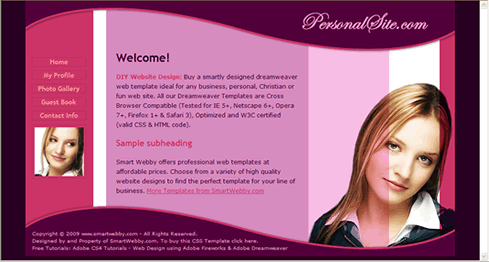
Good Design Features
Robin Williams
One of the elements of good web design is a lack of the elements that make bad web design. If you stay away from everything listed on the page about dorky web pages, you've probably got a pretty nice web site. In addition, keep these concepts in mind:
Text
- Background does not interrupt the text
- Text is big enough to read, but not too big
- The hierarchy of information is perfectly clear
- Columns of text are narrower than in a book to make reading easier on the screen
-
- Navigation
- Navigation buttons and bars are easy to understand and use
- Navigation is consistent throughout web site
- Navigation buttons and bars provide the visitor with a clue as to where they are, what page of the site they are currently on
- Frames, if used, are not obtrusive
- A large site has an index or site map
- Links
- Link colors coordinate with page colors
- Links are underlined so they are instantly clear to the visitor
- Graphics
- Buttons are not big and dorky
- Every graphic has an alt label
- Every graphic link has a matching text link
- Graphics and backgrounds use browser-safe colors
- Animated graphics turn off by themselves
-
- General Design
- Pages download quickly
- First page and home page fit into 800 x 600 pixel space
- All of the other pages have the immediate visual impact within 800 x 600 pixels
- Good use of graphic elements (photos, subheads, pull quotes) to break up large areas of text
- Every web page in the site looks like it belongs to the same site; there are repetitive elements that carry throughout the pages